Alan Pangborn
Needful ThingsAlan Pangborn is Castle Rock’s elected sheriff, a conscientious lawman whose investigation of the town’s spreading violence is inseparable from his unresolved grief for his wife, Annie, and son, Todd. He approaches Leland Gaunt first as a local official trying to understand a suspicious new business, then as a detective troubled by evidence that does not fit, and finally as the man able to see through Gaunt’s attempt to manipulate him. His defining conflict is between private pain that repeatedly threatens to overwhelm him and a public duty he insists on carrying out.
Identity and the sheriff’s oath
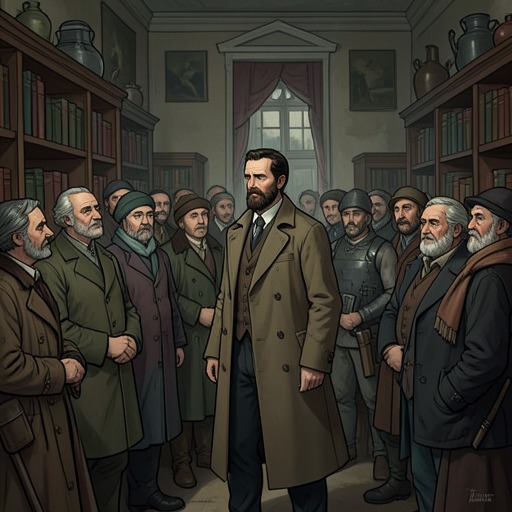
Alan has succeeded Sheriff George Bannerman, whom the town remembers as an especially difficult predecessor to equal. The comparison establishes the burden attached to the office: Alan is considered a good man, yet he occupies a position shaped by the community’s memory of Big George. His own understanding of the job rests less on inherited stature than on obligation. As an elected official, he tells a local political opponent that the selectmen may control the town’s purse strings, but voters chose him to protect them and uphold the law. For Alan, that oath marks a boundary that local politics should not erase.
His ordinary presence is deliberately unshowy. After visiting Portland, he drives down Main Street in a 1986 Ford station wagon, described as the family car, toward the Municipal Building, which houses the sheriff’s office and police department. He has had only three beers, but feels low and half-drunk. The scene places the public official inside the visible remains of domestic life: even the vehicle that carries him back to work is associated with family, at a time when his family has been reduced to memory.
Grief and private life
Alan’s grief is bound to a specific regret. For months before Annie and Todd died, he had been distracted; he believes that closer attention to Annie might have changed what happened. On the morning they left in the old Scout to run an errand at Hemphill’s Market, he was in his study. Looking back, he can find no unusual sign in Annie’s behavior that would have warned him. That absence does not console him. Instead, it leaves him repeatedly revisiting a morning that offered no clear clue to the loss that followed.
The novel shows how this inward blame can abruptly break through his composed manner. While Polly Chalmers is with him, Alan seizes her hand and cries that he misses Annie and Todd. His outburst is not simply a disclosure of sadness: it gives voice to the counterfactual guilt he has been carrying, and to a grief that has not become manageable with time. At another point, depression that had been following him suddenly overwhelms him. These episodes make his investigation emotionally precarious without making it merely an extension of his bereavement.
His relationship with Polly is a source of intimacy and a test of his openness. At Nan’s Luncheonette, he notices from her expression that her arthritis is bad enough for her to have taken Percodan, unusual for her. He has already spoken honestly with her about the confusing, painful feelings surrounding the accident that killed Annie and Todd, partly because he wants to know whether she understands anything about Annie’s state of mind that he does not, and partly because candor is part of his nature. He calls Polly to check on her and asks whether she needs anything; she tells him she is fine, though she is not. Their care for one another is real, but the strain and silences created by Gaunt’s interference later make Alan fear that he may lose her permanently.
Investigating Needful Things
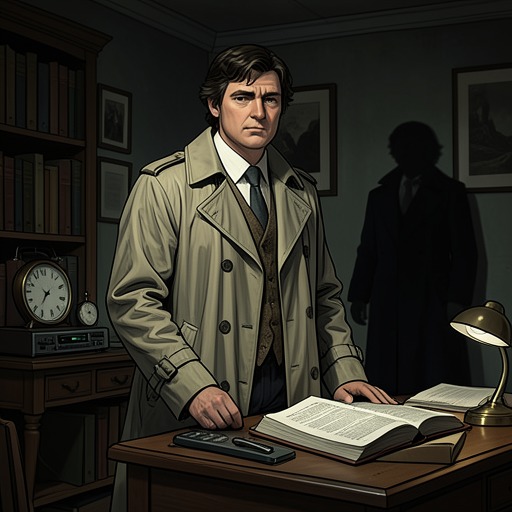
When Gaunt’s new shop has been closed for nearly two hours, Alan returns to the Municipal Building and records the name Needful Things in a battered notebook. He writes down Gaunt’s name and tries to recall the city associated with him, correcting Cleveland to Akron before adding a note to check it out. The small uncertainty unsettles him: he wonders whether he is losing his mind. The notebook entry is a modest but consequential act of attention, the first recorded step in treating the shop and its proprietor as matters for investigation rather than local novelty.
Alan makes a point of going to the shop himself. On a Saturday morning when the sheriff’s office is unusually quiet, he says he is going upstreet to meet Gaunt. He arrives while Gaunt watches from the show window, but misses him. Alan leaves a card welcoming the proprietor to town and offering to have coffee; he says he will try again on Monday. The note is courteous and ordinary, yet it establishes that the sheriff intends to keep contact with Gaunt. Gaunt, reading both sides of the card, understands that Alan plans to return and observes that something has happened to make him more dangerous than before. The exchange pits Alan’s routine public manner against Gaunt’s early recognition that the sheriff’s private losses may make him unusually difficult to manage.
Alan’s investigative instincts become clearer when he refuses to accept the apparent explanation for the deaths of Nettle Cobb and Wilma Jerzyck. The physical outcome looks straightforward: two women have died after a fight, and the kitchen implements involved seem to make the cause of death obvious. The unresolved question for Alan is why the fight happened. He cannot reconcile the sequence in which Nettle supposedly finds her dog dead and then writes the notes that help provoke the conflict. Each time he tries to imagine that sequence, it fails to make sense, and he worries about how much of the case he is not seeing. He reasons that if Wilma did not set the events in motion, someone wanted Nettle to believe she had. The question shifts his attention from the fatal confrontation alone to the possibility that it was engineered.
The investigation also depends on Alan’s ability to notice that witnesses and suspects may be frightened rather than simply uncooperative. When he assesses Brian Rusk, he sees a young person in serious distress and considers two possibilities: Brian witnessed whoever vandalized the Jerzyck home, or he committed the vandalism himself. Either possibility makes him relevant to the case; the second would mean Brian is carrying intense guilt. Alan does not begin by treating the boy only as a suspect. He asks what he is afraid of and presents his badge as a reason he might be able to make the frightening situation go away. This approach reflects his belief that the office carries a protective responsibility as well as authority.
Duty amid a collapsing town
Alan’s investigations unfold while civic life becomes increasingly disordered. The sheriff’s office can be nearly empty even as religious and political disputes occupy the town: on one Saturday, colleagues are away, and a letter defending Casino Nite is being prepared amid hostility between Reverend William Rose and Father John Brigham. Alan’s earlier insistence that politics must stop at the point where the law and public protection begin is therefore tested by more than private criminal cases. The town’s conflicts make the distinction he draws between elected authority and political pressure increasingly consequential.
His caseload also gives him a way to manage distress. When he fears that Polly’s condition and their relationship are consuming him, he deliberately turns his attention to Hugh Priest, whom he suspects may have brought about the deaths of two women. He recognizes relief in concentrating on the case. This is not evidence that the grief or relationship has been resolved; it shows instead how professional focus can temporarily organize feelings that otherwise threaten to overtake him. Alan’s sense of duty can sustain action, but it can also become a shelter from painful questions he cannot yet answer.
That balance is repeatedly tested by the evidence. A call from Andy Clutterbuck prompts a renewed look at the double murders, and Alan asks Henry Payton of the State Police to discuss what troubles him. He describes not just uncertainty about individual details but a problem with the case’s timetable: the accepted sequence does not hold together in his mind. This is the work of a detective who is willing to distrust a tidy explanation when its steps cannot be made plausible. The distinction matters in a town where Gaunt’s influence depends on people accepting false explanations and turning their anger against one another.
Seeing through Gaunt
Gaunt’s manipulation reaches into Alan’s relationship with Polly, and the resulting estrangement leaves Alan believing he may have lost her for good. When they speak again, Polly tells him she understands that Gaunt has been playing them against each other, as he has done to others in Castle Rock. Alan has to decide whether to remain with that personal crisis or act on what he has learned. He orders that Henry Payton be contacted and that Gaunt be taken into custody, initially as a material witness. The request marks a change in the investigation: Gaunt is no longer merely the proprietor Alan hoped to meet for coffee but a person Alan intends to place under official scrutiny.
The decisive clue arrives through Gaunt’s videotape. Alan watches it despite the warning he associates with Brian Rusk, and the display begins with a countdown before the recording continues. The images and information lead him to recognize that Ace Merrill caused the crash that killed Annie and Todd. The discovery converts his long-standing guilt into a sharply directed desire for revenge. It also gives a concrete explanation for the family tragedy that Alan had repeatedly examined without understanding. For a moment, knowing who caused the crash threatens to make retribution feel like justice.
Alan’s interpretation of the tape is not complete at first. Polly reaches him before he can leave, tells him she is no longer angry, and identifies Gaunt’s familiar method of setting people against each other. Alan nevertheless feels compelled to go. Then he notices that Annie’s seat belt was still fastened in the recording, despite Gaunt’s account, and realizes that Gaunt has got the detail wrong. The inference makes the tape evidence to be examined rather than a command to act on its most emotionally charged conclusion. Alan turns away from the revenge mission that the revelation has awakened and keeps his attention on Gaunt’s deception.
Change and narrative role
Alan’s significance rests on the collision of two forms of investigation: the public search for the cause of Castle Rock’s violence and the private search for an explanation of his family’s deaths. Gaunt exploits the second to threaten the first, using Alan’s grief as leverage and encouraging him to turn knowledge into vengeance. Alan’s characteristic skepticism—his unwillingness to let the timeline of a case pass merely because the apparent outcome seems obvious—eventually applies to the evidence most capable of overpowering his judgment. He notices the discrepancy about the seat belt and recognizes that Gaunt’s version cannot be trusted.
The final emotional note is not a claim that Alan’s loss has vanished. He tells Polly that what belongs in the darkness should remain there, invoking the words that frame release as a choice rather than erasure. His arc moves from self-blame and isolation toward renewed trust and a refusal to let grief dictate his next action. He remains a lawman whose duty is grounded in an oath, but his decisive victory over Gaunt also depends on a harder personal discipline: distinguishing the truth from the story that would make revenge seem inevitable.